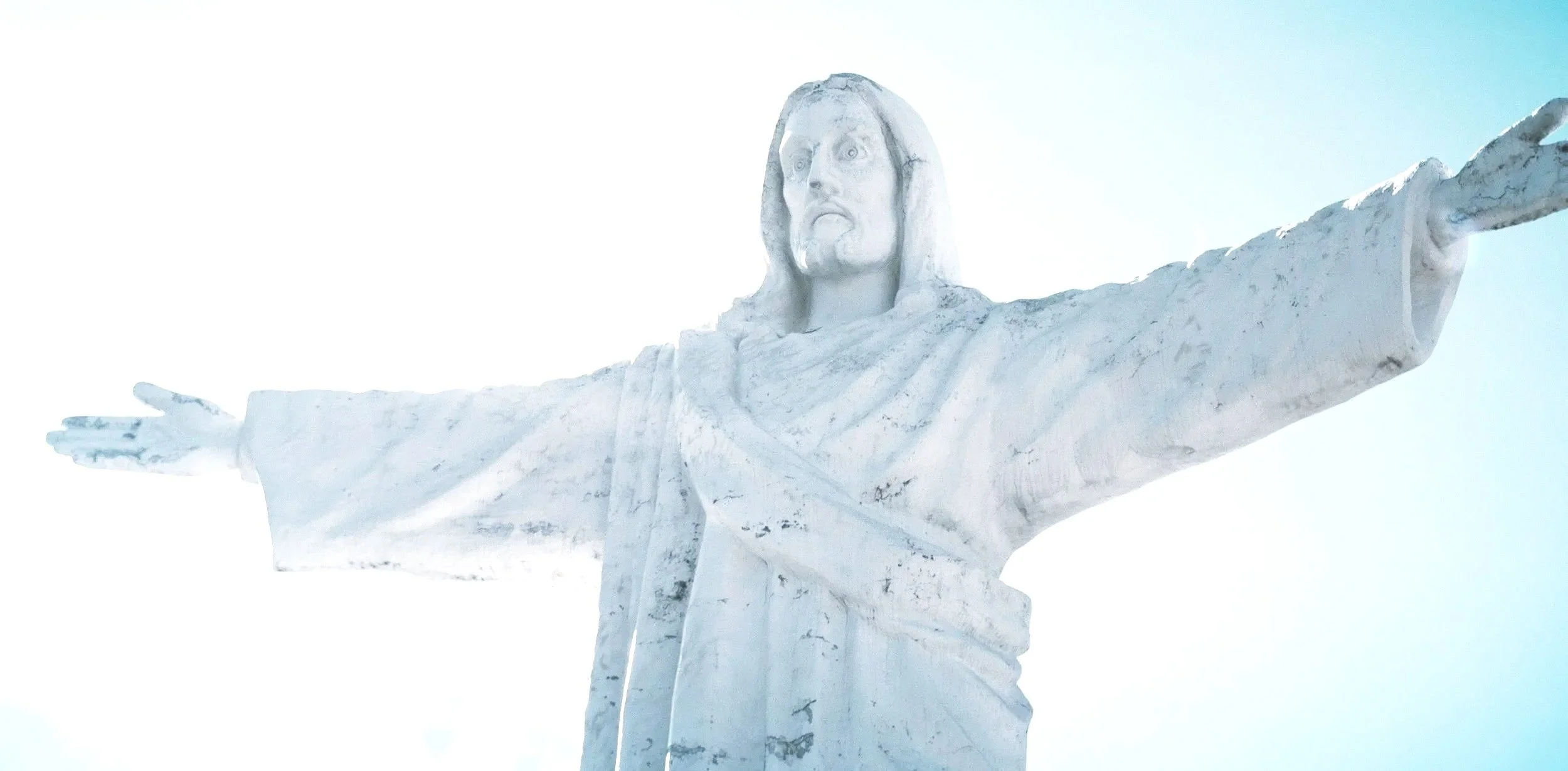
CHRISTIAN COMMUNITY IN LIMA CENTER
The small church, the Realm of God, and where Jesus’ hangs out in Lima, Rock Country, Wisconsin (and - SURPRISE! - it isn’t just church)
In a world that emphasizes that more is best, bigger is better, filled with grandiose statements and superlatives by blowhards, small congregations like ours can go overlooked. We admit that large churches, including megachurches, are the big box stores of religiosity. They have many products to offer religious shoppers, some of them quite good. Nevertheless, here are some things to keep in mind about small congregations:
2000 years ago, the early church started out small. When congregations outgrew gathering in homes, they didn’t build bigger buildings: They calved new small congregations throughout the Roman Empire. It is only when the Empire became “Christian” in the 4th century that the Empire turned over public buildings (basilicas = Empire buildings) to churches and churches could accommodate large gatherings of people indoors. The trade-off was that the rapidly growing house-church Christian faith slowed to become building-bound and property-burdened.
Jesus and his followers created small churches to be “seed” “communities of practice” throughout the Roman Empire. Small congregations would be created throughout Roman provinces to model what Jesus called the Realm of God (see the meditation below) and then invite the local population into them. Then the process repeated itself. Per this model, God put North Lima church where it is to invite the people of Lima Township to know and love Jesus Christ and to help them live as citizens of the Realm of God.
Small churches don’t have large institutional concerns, such as supporting big buildings and staffs. They can focus on sharing God’s loving good news with people outside the church, without the agenda of “needing new people to give financial support to keep the place running.”
Small churches work through their individual church members to reach out and touch members of the larger community: The individual members ARE the transformative missions and ministries that God calls the church to be. Individual church members through relationships help community members find justice, forgiveness, kindness, and the people and places they can trust. Church members don’t need the authorization of a preacher or church hierarchy to do as Jesus wants them to do.
Small churches are nimble. They recognize that they can meet without their buildings, as much as they love their buildings; they can risk, fail, die, and be reborn until they get to where Christ needs them to be.
Small congregations can share their buildings and grounds to be pre-schools, community centers, libraries, exercise centers and community gardens, and much more, because the congregations themselves don’t need all the space.
When small churches are blessed with wizened members (code for old folks) as well as younger ones, they have a unique opportunity: The combination of experience, wisdom, energy, and vision shared respectfully across generations can be powerful, interesting, and even fun i.e., if everyone possesses a servant’s heart and a commitment to jump in and help as best they can.
It is a great thing to appreciate the small church and its ability to address personally your spiritual journey. Try it; you never know. It might just be God’s place for you, the place of support for your pilgrimage.
THE SMALL
CHURCH
A Meditation on Jesus’ Ministry, the Realm of God, and the Lord’s Prayer
“Woe to you, teachers of the law and Pharisees, you hypocrites! You give a tenth of your spices—mint, dill and cumin. But you have neglected the more important matters of the law—justice, mercy and faithfulness. You should have practiced the latter, without neglecting the former.” Matthew 23:23
Jesus was non-violent. Nevertheless, he fought with words and significant actions against the cultural, political, economic, and religious authorities of his day. To keep their institutions intact, thereby guaranteeing their position and power, these authorities often exploited regular folks. This oppression troubled Jesus greatly. He both confronted these authorities and taught those who listened to him to be aware of the authorities’ lies and manipulative actions.
Jesus comforted those who worked hard and still had trouble paying for their daily bread. No wonder Jesus urged people to pray and work for fair wages, yet also to share what they had over and above, specifically with those in greater need!
The common people, with whom Jesus identified, paid exorbitant taxes to Rome. They were sliding deeper into debt. Debt made people poor and left them unable to borrow more money to stay afloat. Eventually they lost their farms and small businesses. No wonder Jesus argued so vehemently for debt forgiveness!
As a consequence of dire poverty, hurting people turned on each other for the sake of their survival. Trust was so broken - between institutions and people, between individual people, between people and God - that it became very hard to imagine either having a future or trusting that any good would come from it. People became so desperate, no wonder Jesus warned against being driven by future temptations to harm others!
We hear Jesus’ three admonitions above in that most well-known of prayers, The Lord’s Prayer: “Give us this day our daily bread; and forgive us our debts, as we forgive our debtors. And lead us not into temptation, but deliver us from evil.” Jesus did not separate spiritual problems from material problems. As we hear in the biblical book of James (and paraphrase here), you don’t say “God bless you“ to someone in need and not do something to respond to that need.
The crisis of Jesus’ day was not just individual: It was corporate and global.
It is the nature of empires, dating back to the Hittites through present day America, to exacerbate inequalities and grind people down. Democracies like ours may make a greater effort to guarantee equal rights for people. Nevertheless, when national leaders in every field lack humility, and make greed their first priority, the people they govern suffer and eventually lose their ability to exercise their rights. Political, economic, and religious liberties are intertwined with each other, as Presbyterian and Declaration of Independence signer John Witherspoon once observed.
Jesus taught that there is an alternate Empire that lies parallel to every other empire, including ours. It is among us, yet hidden in plain sight. It is based on love, not coercion, although not love defined as mere feeling. The love Jesus taught was quantifiable and objectively measurable in human organizations and in individual virtue.
Jesus called this contrasting Empire, the Empire, Kingdom, or Realm of God. It should come as no surprise that Jesus described the three main characteristics of the Realm of God as social justice, acts of mercy, and trust in God’s future. Jesus speaks of the Realm of God in many of his teachings, and it plays a dominant role in The Lord’s Prayer, introduced as its theme at the beginning and concluding with a reminder of the same theme: “Thy KINGDOM (Realm) come, thy will be done, on earth as it is in heaven . . . for thine is the KINGDOM (Realm), the power, and the glory.”
Here are key elements of the Realm of God
The Realm of God is nearby, right beside us, like a parallel universe that shares a permeable membrane with our own. We can access its vision and borrow its energy whenever we want it; we and our congregations can channel it into our families, neighborhoods, civic communities, and work places.
Churches are supposed to be learning and teaching communities. In their practices, they witness to the Realm of God through their internal interactions and they prepare their members for service in the world.
Some day the Realm of God will be fully realized (Christians debate the when and how this will happen). Nevertheless, we are citizens of the Realm of God RIGHT NOW. This may mean that in our hurting culture, we may feel like resident aliens.
A more empowering way for us to self-identify, however, is to consider ourselves ambassadors of the Realm of God. It is our first priority to represent the Realm of God and its right or righteous relationships (justice, mercy, and trust) in all of our interactions, because it was and is Jesus’ first priority.
Remember that our God is a relational Triune God. This means that our creating, fostering, and enjoying loving, gracious relationships are intrinsic activities to being human and faithful. As The Lord’s Prayer tells us, these relationships begin with God, “our Father/Abba/Daddy in Heaven,” a relationship with One who is very different from our human fathers and mothers. Nevertheless, our human parents at their best may show us glimpses of some of God’s beautiful qualities.
The prayer as a whole, written in traditional Presbyterian terms (which is one of two ways that is closest to Jesus’ intent, the other being the expression of “trespasses and trespassers;” think of how debtors suddenly become trespassers on their own property when deprived of ownership of the latter by debt), is below.
OUR FATHER WHICH ART IN HEAVEN, HALLOWED BE THY NAME. THY KINGDOM COME, THEY WILL BE DONE, ON EARTH AS IT IS IN HEAVEN. GIVE US THIS DAY OUR DAILY BREAD; AND FORGIVE US OUR DEBTS, AS WE FORGIVE OUR DEBTORS. AND LEAD US NOT INTO TEMPTATION BUT DELIVER US FROM EVIL. FOR THINE IS THE KINGDOM, AND POWER, AND GLORY FOREVER.
WHILE YOU SEARCH FOR A CONGREGATION, PLEASE REALIZE THAT GOD IN CHRIST, THROUGH THE PRESENCE OF THE HOLY SPIRIT, WALKS WITH YOU. WE HOPE THE BIBLE STUDY BELOW IS REASSURING AND HELPFUL.
HERE ARE THREE KEY UNDERSTANDINGS TO KEEP IN MIND AS YOU READ THROUGH IT.
In our experience, following the Living Christ is far easier with the support of a community of faith to nurture it.
Witnessing to the social justice, mercy, and trust characteristic of the Realm of God requires at least two people in relationship to practice these qualities.
Nevertheless, the Living Christ is not trapped in church buildings. Indeed, other than weekly worship, many faithful activities are intended to be practiced outside of church (BTW,“church” meaning at least two or three people gathered in Jesus’ name; that is enough to be a church, according to Jesus). Two of these activities, for example, are our individual service to needy folks and our efforts at personal spiritual formation .
Below are listed the 25 places and ways Jesus promises to reveal himself, making himself accessible to us, according to the Gospel of Matthew: We hope that this walk through Matthew will help you see Jesus’ face and body even on gray days.
I. In the fulfillment of the law (of love) (Matthew 4:17, 12:8-10, 17:3-6)
2. Among the disempowered and disinherited (Matthew 8:19-22, 21:42; 25:31-46)
3. In forgiveness of sin (overcoming alienation) (Matthew 9:6)
4. In the call to repent and follow (Matthew 9:9, 13)
5. In the apostolic mission of sharing the good news (Matthew 4:19, 10:40-42, 23:34)
6. In the courageous response to persecution (Matthew 10:21)
7. In merciful ministries of healing and exorcism (Matthew 11:2-6, 12:27, 28)
8. In revelations of the Kingdom (Realm) of God (Matthew 13:11)
9. Where there is faithful expectation i.e. hope (Matthew 13:58, 14:28, 29, 15:28)
10. In the church where the gospel is proclaimed (Matthew 16:18, 19)
11. Where there is self-denial for the sake of service (Matthew 16:24)
12. In the approaching future (Matthew 16:28, 19:28-30, 23:39, 24, 26:64)
13. In the confrontation with the power of death (Matthew 17:23, 24, 20:18-23)
14. In the welcome of children (Matthew 18:5)
15. In faithful dialogue (Matthew 18:20)
16. In the voluntary surrender of worldly goods (Matthew 19:21)
17. In humble service (Matthew 20:28, 21:5)
18. In sincere and inclusive worship (Matthew 21:12-16, 26:13, 28:17)
19. In discontinuity with ultimate human claims of authority (Matthew 21:23, 22:21, 23:9-11).
20. In the resurrection (Matthew 22:32)
21. In our fragile humanity symbolized in the Lord's Supper (Matthew 26:26-29)
22. In the fulfillment of Scriptures (Matthew 26:54)
23. In crucifixion (Matthew 27)
24. In our next steps as we take them (Matthew 28:7)
25. In the church's witnessing, baptizing, and teaching ministries (Matthew 28:18-20)
Summary: (Note that Christ is always found in some type of community, with people, however small a group).
1. In the gathered church, such as in worship and in prayerful dialogue among the members.
2. In the pain and innocence of the most vulnerable, e.g. poor and children.
3. In any effort to share the good news of God's saving love as experienced through Jesus, such as in evangelism, personal witness, preaching and teaching, the church's education program, etc.
4. In the promised future that is coming to us, toward which we are headed and to which we are called to be open in mind and heart.
5. In any event in which selfless love - ἀγάπη - is experienced.
JESUS: “SEE YOU EVERYWHERE!”